If you need water analysis for pesticides in CT, professional laboratory testing can help determine whether pesticide compounds may be present in your drinking water. Pesticides include a broad range of chemicals used in agriculture, landscaping, lawn care, vegetation management, pest control and other applications. Because pesticides can enter groundwater and surface water through runoff, infiltration and environmental migration, many Connecticut property owners choose to perform a professional water analysis in Connecticut to evaluate their drinking water quality.
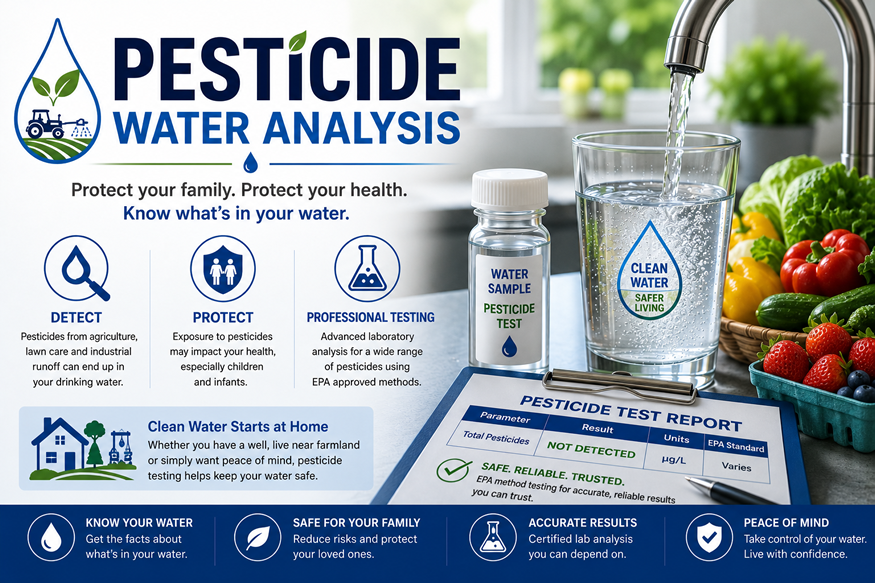
Pesticides are among the most complex contaminants routinely analyzed during a water analysis. Unlike many contaminants that can be evaluated through a single laboratory procedure, comprehensive pesticide water analysis generally requires multiple laboratory methods because different pesticide families have different chemical properties. For this reason, several separate tests may be necessary to provide broad pesticide coverage.
Why Water Analysis for Pesticides Is Important
Many pesticides are colorless, odorless and tasteless at concentrations that may be detectable through laboratory testing. As a result, Connecticut property owners typically cannot determine whether pesticides are present based solely on the appearance, smell or taste of their water.
A professional water analysis for pesticides in Connecticut may be recommended for:
- Private well owners
- Home buyers and real estate transactions
- Agricultural properties
- Properties located near farms, orchards or crop fields
- Residential properties with extensive lawn treatments
- Commercial and industrial properties
- Child care facilities and schools
- Properties with a history of pesticide use
- Routine drinking water quality evaluations
Because pesticide contamination can originate from both current and historical applications, testing is often recommended whenever groundwater quality concerns exist.
Comprehensive Pesticide Water Analysis in CT
One of the most common misconceptions regarding pesticide testing is that a single laboratory analysis tests for all pesticides. In reality, there are thousands of pesticide products and hundreds of active ingredients. Comprehensive pesticide screening typically requires multiple laboratory methods.
To provide broad pesticide coverage, pesticide testing commonly includes:
- EPA Method 504
- EPA Method 507
- EPA Method 508
- Glyphosate Analysis (Roundup® and similar products)
Together, these analyses provide much broader pesticide coverage than any individual test alone.
EPA Method 504 primarily targets certain chlorinated pesticides and related compounds that may be found in drinking water. This method is often used to identify specific pesticide compounds that require specialized analytical procedures.
EPA Method 507 focuses on numerous nitrogen- and phosphorus-containing pesticides and herbicides. These compounds are commonly associated with agricultural, commercial and residential pesticide applications and are not fully covered by other pesticide methods.
EPA Method 508 analyzes a broad range of chlorinated pesticides, herbicides and related organic compounds. This method expands pesticide coverage beyond what is included in Methods 504 and 507 and is commonly used as part of a comprehensive pesticide water analysis program.
Glyphosate testing is generally performed separately because glyphosate, the active ingredient found in Roundup® and many similar herbicide products, requires a specialized analytical procedure that is different from the methods used for many traditional pesticide compounds. EPA Method 547 was developed specifically for glyphosate analysis in drinking water.
Because no single test covers every pesticide compound, the combination of EPA Methods 504, 507, 508 and glyphosate analysis provides some of the most comprehensive pesticide screening available for drinking water supplies.
Common Sources of Pesticides in Connecticut Drinking Water
Pesticides may enter groundwater and drinking water supplies through a variety of pathways. Potential sources identified during water analysis in CT investigations may include:
- Agricultural pesticide applications
- Crop production and farming activities
- Orchards and vineyards
- Lawn care and landscape treatments
- Golf course maintenance
- Commercial vegetation control programs
- Roadside and utility right-of-way spraying
- Historical pesticide applications
- Groundwater migration and runoff
- Improper storage or disposal of pesticide products
The presence of pesticides in groundwater often depends upon local geology, soil conditions, land use, groundwater flow patterns and the type of pesticide involved. Some compounds degrade relatively quickly, while others may persist in the environment for extended periods.
For this reason, laboratory water analysis for pesticides in Connecticut remains the most reliable method for determining whether pesticide contamination may be affecting a drinking water supply.
We provide professional water analysis for pesticides in CT, including comprehensive pesticide screening using EPA Methods 504, 507, 508 and glyphosate analysis. Whether you are evaluating a private well, purchasing a home, investigating a potential contamination concern or monitoring drinking water quality, professional water analysis in Connecticut can provide accurate laboratory results and valuable information regarding pesticide contamination in your water supply.
Call today to schedule your water analysis for pesticides in your Connecticut drinking water!
888-558-1574